

Choosing intention over distraction in your daily scroll
We’ve all seen the posts:
“Stop scrolling.”
“Put down your phone.”
And then they go on to tell us how damaging it can be emotionally, physically, to our relationships, and even to our spirituality.
We fall down rabbit holes.
We lose hours doomscrolling.
We get angry.
We fall for lies.
Our necks are bent down, our shoulders are tight, never looking up to see what’s going on around us, and by the time we realize it, we’re slumped over, discouraged, and wondering where the time went. We’ve wasted hours, strained our posture, and started to believe—God knows what.
Now, those are all well meaning posts. The creators want to help. They want to share how choosing to put down their phones has helped them learn a new skill, reconnect with friends and family, feel less anxious, or even get into better shape because they swapped scrolling for strolling outside.
But… how would we know any of this if we weren’t scrolling?
Kind of ironic.
If I told you to put down your phone and stop scrolling, you would most likely never see any of my posts. That kind of defeats my purpose of digital marketing and connecting with others online.
Technology, in and of itself, isn’t the enemy. We have a wealth of information in the palm of our hands. I used to spend hours at the library collecting information for school reports, lugging around books and flipping through pages. Now I can sit in the comfort of my own home and quickly look up how something works or find a definition.
I can learn new things to improve my art.
I can be inspired.
I can stay connected with loved ones.
For me, one of the best parts is having access to Biblical references, devotionals, and even meditation apps like Abide. I can also volunteer online and encourage others who are going through difficult seasons of life.
Social media has its pros and cons. It’s up to us how we engage with it responsibly.
So instead of stopping our scroll, maybe we just need to slow it.
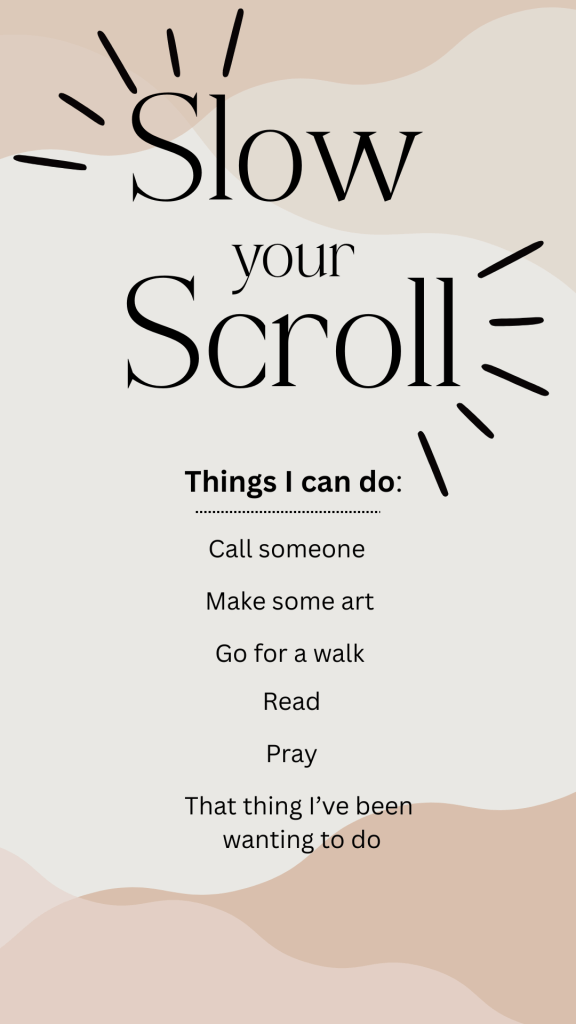
Here are a few ways to be more intentional online:
Time yourself.
Set a timer on your phone—or better yet, somewhere else in the house—so you actually have to get up to shut it off.
Check your screen time.
Most phones provide a weekly report that shows how much time you’ve spent scrolling. It can be eye-opening.
Have an accountability partner.
Find someone who will encourage you to be intentional with your time online.
Curate your feed.
Be intentional about what shows up in your social media. My feeds consist of art tutorials, devotionals, beach and ocean groups, animals, food, migraines, and of course, my family and friends. I block anything that stirs up unnecessary anger, sadness, or negativity.
There are plenty of content creators whose goal is simply to stir things up. You don’t have to give them your time or attention.
If you know me, you know I love to volunteer. There are actually ways to do that from the comfort of your own home thanks to technology.
I volunteer as a Digital Outreach Volunteer for Focus on the Family. Each week I respond to posts on social media platforms from people who are looking for answers to some of life’s harder situations. It’s a simple way to spread God’s love, share His Gospel, and plant seeds of hope.
The internet can be a dark place that needs God’s light. That’s why it’s important for me to be mindful of what I’m doing online. It’s so easy to say, “Let me just check one thing on Facebook,” and before I know it, three hours have passed and I’ve accomplished… nothing.
To help you slow your scroll, I’ve created a free phone wallpaper as a reminder to be intentional about how you spend your time online. Feel free to download and share it.
There are some really great things we can learn from social media. I’m not saying stick your head in the sand. If you needed to lose weight, I wouldn’t tell you to stop eating—I would advise you on how to do it in a healthy way.
The same goes for scrolling.
Scroll responsibly.
What do you do to help yourself be more intentional online? Leave it in the comments and share what works for you.
Until then,
Anchor in Hope.










 The Kedge Anchor

You must be logged in to post a comment.