

Gratitude, Trust God

The Importance of Thankfulness: Remembering God’s Faithfulness in Every Season

Old family photo with AI enhancement – Thanksgiving 1985

“O taste and see that the LORD is good: blessed is the man that trusteth in him.” — Psalm 34:8

Thanksgiving is Thursday, and before we get caught up in preparing meals, gathering with friends and family, it’s worth stopping to consider what thankfulness really means.

It’s easy to associate Thanksgiving with a particular day, a beautifully prepared meal, or a list of things we’re grateful for. But what about the other 364 days of the year? What does a thankful heart look like when life isn’t going quite as planned or we are waiting on God for an answer?

I think it has something to do with where we’re looking, what we’re paying attention to, and whether we’re willing to recognize God’s goodness in the everyday moments of life.

I’ve been thinking about three things: remembering, recognizing, and trusting.

Remember What God Has Done

Psalm 103:2 tells us:

“Bless the LORD, O my soul, and forget not all his benefits.”

There’s something important about remembering. We can become so consumed with today’s circumstances, the uncertainty of tomorrow, or the things we wish were different that we forget how God has already come through for us.

In Joshua 4, we find a wonderful example of the importance of remembering.

After God parted the waters of the Jordan River and allowed the Israelites to cross on dry ground, He instructed Joshua to choose twelve men, one from each tribe, to take twelve stones from the riverbed.

These stones were to become a memorial. When future generations asked, “What do these stones mean?” the Israelites would have an opportunity to tell them what God had done.

I love that picture. God knew how important it would be for His people to remember.

Those stones weren’t just rocks piled together. They were reminders of God’s faithfulness, provision, and power. They gave the people something tangible to look at and a reason to tell the story of what God had done.

We need those reminders, too.

Think about the times you didn’t know how something would work out, when you couldn’t see a way forward, or when you wondered how you would get through a particular season.

And yet, here you are.

God has been faithful. He has provided, sustained, comforted, and carried us through things we may not have thought we could endure.

Sometimes we need to look back, not to dwell in the past, but to remember God’s faithfulness.

Perhaps we need to create our own memorial stones: reminders of answered prayers, unexpected provision, doors God opened, and the times He carried us through.

Don’t let today’s uncertainty cause you to forget yesterday’s provision.

Recognize His Goodness in the Moment

First Thessalonians 5:18 tells us:

“In every thing give thanks: for this is the will of God in Christ Jesus concerning you.”

Notice that Scripture says to give thanks in everything. Not for everything and not just when everything is going our way.

That doesn’t mean we pretend difficult circumstances don’t exist or that we’re thankful for every hardship. It means we don’t lose sight of God’s goodness in the middle of them.

This brings me to an interesting account in Luke 17:11–19.

Jesus encountered ten men with leprosy. They called out to Him for mercy, and He told them to go and show themselves to the priests. As they went, they were cleansed.

But something interesting happened.

One of them, when he saw that he was healed, turned around and went back to Jesus.

He saw it. He recognized what had happened. In that very moment, he stopped what he was doing, turned back, and glorified God. He fell at Jesus’ feet and gave thanks.

All ten received the blessing, but only one returned to acknowledge the One who gave it.

I find myself wondering how often we, I do the same thing. We pray, God answers, and we move on to the next thing. We’re so focused on what’s ahead that we don’t stop to recognize what God has done right in front of us.

Don’t be so busy looking for the next blessing that you miss the blessing in front of you.

Sometimes thankfulness is simply being present enough to recognize God’s goodness when we see it.

Trust Him With What Is Yet to Come

What happens when you’re at a crossroads? When you’re facing a decision, trying to discern God’s will, or wondering what the future holds?

It’s easy to become consumed with the unknown. We want answers. We want direction. We want to know which way to go.

We spend a lot of time asking God to reveal His will for our lives. And rightly so. But sometimes, in our search for what He wants us to do next, we overlook something He has already made clear.

Let’s look again at 1 Thessalonians 5:18:

“In every thing give thanks: for this is the will of God in Christ Jesus concerning you.”

Read that again. Giving thanks is the will of God.

We may not know what tomorrow holds. We may not have clarity about the decision in front of us or understand where God is leading. But we don’t have to wait for those answers to live out His will today.

We can give thanks.

That doesn’t mean we stop seeking His direction or that every decision suddenly becomes clear. It means that while we’re waiting, praying, and discerning, we can choose to have a thankful heart.

We don’t have to know how everything will work out to trust the One who does.

The God who has been faithful in the past knows what we need today and what lies ahead tomorrow.

We can look back and remember His faithfulness. We can look around and recognize His provision today. And we can look ahead with confidence in the One who knows what we need.

A Thankful Heart

Perhaps thankfulness is less about making a list of everything we have and more about recognizing the goodness of the One who provides.

Remember what He has done. Be present enough to recognize what He is doing. Trust Him with what is yet to come.

We may still be waiting for God to reveal what He wants us to do next, but He has already told us something He wants us to do right now: Give thanks.

And in every season, take the time to stop, turn around, and give Him thanks.

“O taste and see that the LORD is good.”

Don’t just hear about His goodness. Don’t just remember it from yesterday. Look for it today.

And when you see it, don’t forget to give thanks.

Moment to Reflect

1. Remember: What is one way God has shown His faithfulness in your life that you don’t want to forget?

2. Recognize: What blessing in your life today might you be overlooking?

3. Trust: Is there something you’re waiting on God for that you need to surrender to Him with a thankful heart?


art, Design for Life, hope

Design for Life: Proximity – The Power of Drawing Near

Proximity is a principle of art and design that describes the spatial relationship between elements. The distance between objects can communicate connection or separation. It can help organize information, establish importance, and give a design structure.

Proximity generally serves two purposes:

1. Creating connection. Grouping related elements together helps communicate that they belong together. It creates organization, establishes hierarchy, and gives a design shape.

2. Creating separation. Placing unrelated elements farther apart communicates that they don’t belong together. Separation can also help break up information and make a design easier to understand.

In other words, proximity helps communicate a message through the relationships between the elements, whether they are grouped together or separated.

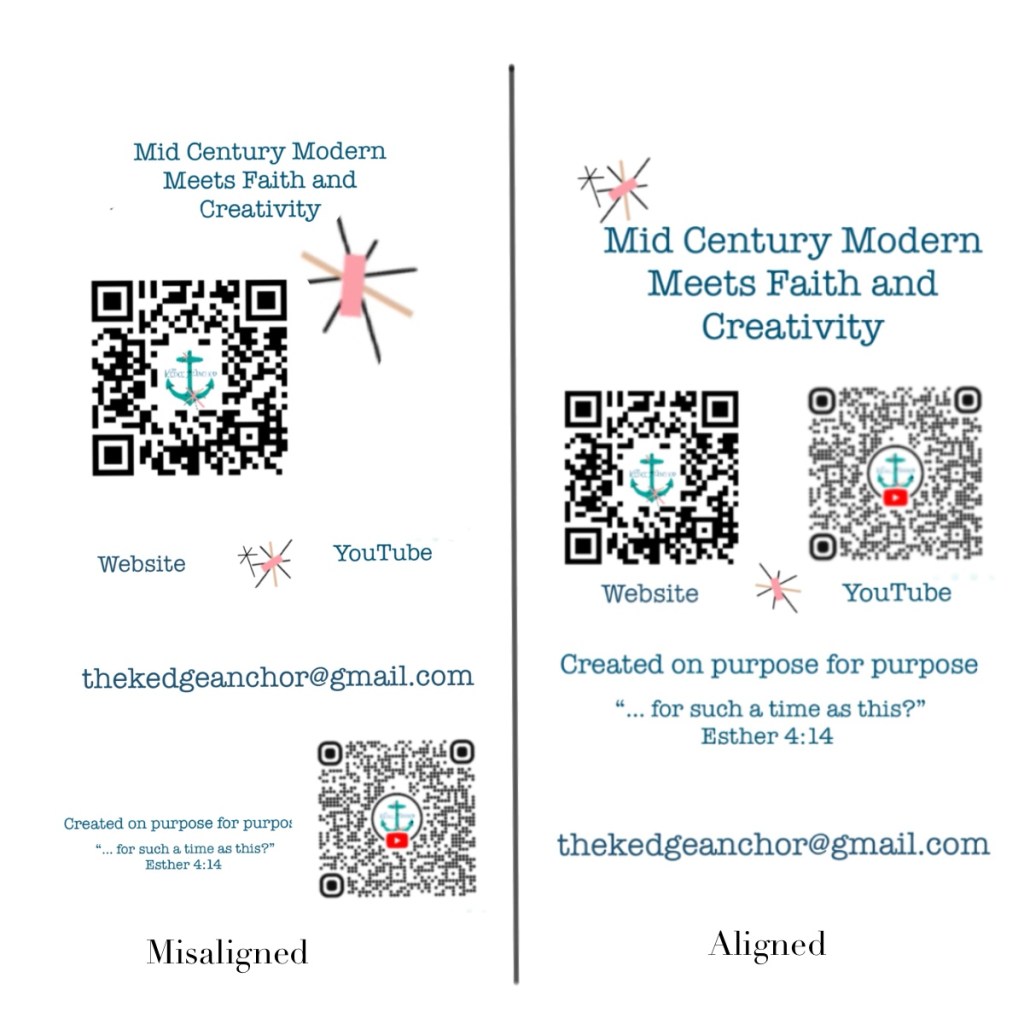
In the first example, the information is in the four corners of this business card. There is no clear hierarchy to help the reader understand what is most important or which details belong together.

In the second example, related information is grouped together, making the business card easier to read and understand. The content hasn’t changed, but the arrangement makes all the difference. All the related info is grouped together. The owner’s name and the name of the business are on the left and the contact information is on the right.

The same principle can apply to our lives.

If we live our lives in close relationship with God, our lives begin to reflect that connection. The things we draw near to influence us, shape our priorities, and often become evident in the way we live.

James 4:8 gives us this invitation:

“Draw near to God, and He will draw near to you.” (KJV)

But what does drawing near to God actually look like? How do we cultivate that closeness in the middle of everyday life?

In what ways do you feel closer or connected to God? How do you draw near to Him in your daily life? What helps you stay mindful of His presence?

The second part of James 4:8 says:

“Wash your hands, you sinners, and purify your hearts, you double-minded.” (NIV)

Impure hearts and double-mindedness are some of the things that can keep us from experiencing the closeness God desires. But I don’t think it’s always sin itself that gets in the way. Sometimes it’s simply distraction.

Distractions aren’t necessarily sinful, but they can blur our priorities and, if left unchecked, lead us away from the closeness God desires for us.

Over time, I’ve noticed a few things both in my own life and in others that happen when we intentionally draw near to God.

1. He draws near to us.

James 4:8 reminds us, “Draw near to God, and He will draw near to you.”

We are separated from God by sin, but His desire has always been for relationship with us. He’s the One who provided the way through Jesus Christ. God loves us so much that He sacrificed His Son so that we could come near to Him and live in relationship with Him.

Hebrews 4:16 (NKJV) reminds us:

“Let us therefore come boldly to the throne of grace, that we may obtain mercy and find grace to help in time of need.”

We don’t have to approach God timidly or wait until we have everything figured out. Through Jesus, we can come boldly before Him. We can bring our needs, our struggles, our questions, and even our distractions to the throne of grace.

We can live confidently in the closeness He has made possible.

2. We begin to develop Christlikeness.

You can often recognize family members by their mannerisms or speech. Even adopted children begin to mirror their families over time, they pick up phrases, gestures, and habits simply through closeness and living in the same house.

The same happens in our relationships and friendships. The more time we spend with someone, the more we begin to reflect parts of them.

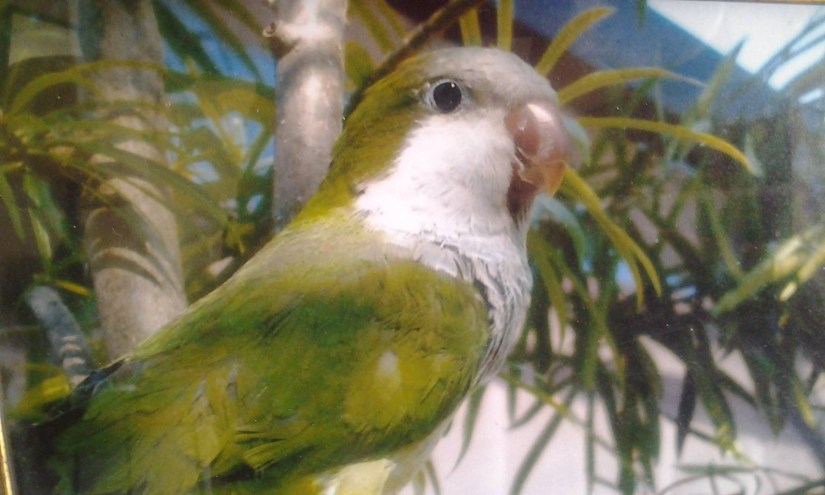
My bird even repeats some of my phrases, like “I gotta check my email” or “Time to go to bed now” simply because she’s heard me say them so often.

In the same way, when we spend time with God, we begin to reflect His character, His words, and His ways. The more we spend time with Him, the more we become like Him.

It’s not about trying to imitate someone from a distance. It’s about knowing Him, walking with Him, and allowing His Word and His Spirit to shape who we are.

3. Others begin to notice.

People will start to see our faith in our reactions and behavior. When we choose kindness over retaliation, or refuse to gossip, others take notice.

They might wonder, “What’s different about her?” or “Why doesn’t she respond the way others do?”

That quiet difference speaks volumes, it points to the One we’ve spent time with.

One passage that comes to mind is the story of Mary and Martha. Mary chose to sit at the feet of Jesus, there’s no closer place to be. Her sister Martha was caught up in preparation and busyness, but Mary chose presence and proximity over activity.

In the midst of chaos, she prioritized proximity to her Lord.

That’s God’s design for our lives too, to stay near Him. Some days it’s easier than others, but the promise remains: when we draw near to God, He draws near to us.

Reflect

1. Are there certain times, places, or practices that make you more aware of His presence?

2. How can you intentionally “draw near” to Him this week?

3. How can you choose to “sit at the feet of Jesus” amid your own busyness or chaos?

Sometimes the most important thing we can do isn’t add something else to our lives, but draw closer to the One who matters most.

art, hope

Design for Life: Alignment — Who’s at the Center?

Art definition: “…it’s the foundation upon which your design stands and appears attractive to the viewers…Alignment refers to the arrangement of different design elements on various positions. Alignment declutters the design and frees it from becoming a disorderly chaos. Believe me; no one likes a design with scattered text and misaligned graphics. It’s the worst design sin anyone can commit!” (https://www.designmantic.com/blog/art-of-alignment-graphic-design

The same information, two different layouts. The card on the right uses consistent alignment to create order and visual flow, while the card on the left shows how shifting elements can disrupt that flow.

When we aren’t aligned with God our lives can become chaotic and disorganized. Not that that is a sin.  I like how this definition states, “Alignment declutters the design and frees it from becoming a disorderly chaos.” I am sure it’s a pleasing sight to God when we are in alignment with Him.

There are four ways to align objects, elements and text in a piece of art.

Center

Justified

Right flush

Left Flush

But when we talk about spiritual alignment – there is only one way – center alignment. To put God at the center of everything. So how do we align ourselves with God? What does it look like and what happens when God is the center of our lives?

Let’s look at what the Bible tells us about alignment. Matthew 6:33 tells us “Seek ye first the kingdom of God…” In Exodus 20:3 we read “Have no other gods before me.” What does this look like in practice? It could be:

– Reading and spending time in God’s word

– Prayer

– Serving, our families, community, church

– Tithes and offerings

  • Using our gifts and talents for God’s Kingdom Obedience
  • Encouraging others

There was a point and there are times where I felt like and feel like my prayers are hitting the ceiling. I begin to wonder if God is hearing me? Why isn’t He answering me. When that happens, I stop and evaluate. What am I doing or not doing? If I am spending time with God and my prayers still aren’t being answered, what gives? It’s not only to whom I am praying but what am I praying for. Are my prayers self centered? Often, I find that what is missing is that I need to pray His will.  “Our Father who art in Heaven hallowed be thy name, thy kingdom come, thy will be done …” I realized I need to pray His will for my prayers to be answered. I needed to align myself with His plan (whatever that is) for me, for others, for the future.

Mike Donehey wrote a book, Finding God’s Life for My Will. I highly recommend reading this book if you are struggling with God’s plan for your life.  I like what he had to say about being successful. “God doesn’t want our success, He wants our surrender.” Whoa. We can align ourselves by making God the center of our lives, by surrendering ourselves, our plans, our desires to Him. We don’t have to work at being perfect, we don’t have to perform, we don’t even have to try. We don’t have to be successful.

And to answer the second part of the first question, what happens when we are aligned? “Seek ye first the kingdom of God And His righteousness And all these things shall be added unto you Allelu, alleluia” maybe you’re familiar with the song?

All these things being, rest, order, joy, peace, fruits of the spirit. Our lives can become free of disorderly chaos. God will also provide our needs. Matthew 6:31-34 tells us that our Father knows all that we need before we do. He tells us not to worry about tomorrow. He will provide as He provides for the birds and we are worth more to Him. His will for us is to be aligned with Him. He is the plan. If we are aligned with Him and we trust Him, we will begin to pray His will and He will lead us to take those steps of faith as Joshua and the Israelites did at the Jordon.

Reflection

What step of faith might God be calling me to take right now, even if I don’t have all the answers.

What is currently at the center of my life?

In what areas of my life do I feel cluttered or in chaos?

How might misalignment be contributing to that chaos?

Let’s reflect together. What stood out to you today? Share in the comments.

art, Design for Life, hope

Design for Life: When Art Meets Faith

What if the principles that make a work of art beautiful could also teach us something about how we live our lives?

Our Heavenly Father is the Master Artist, the Creator of all things. From the smallest living creature to the vastness of the universe, His creation reveals purpose, order, and incredible detail.

John 1:1–3 reminds us that all things were made through Him. Even the materials we use to create art, pigments from the earth, paper from trees, and fibers from plants come from what God has already created.

And what about us? Psalm 139:14 declares that we are fearfully and wonderfully made. Like a potter shaping clay, God forms each of us uniquely. We are not mass-produced or interchangeable. We are His creation, each with our own gifts, experiences, and purpose.

But God’s design for humanity didn’t end with creation. He knew sin would enter the world, and His plan of redemption was already in place. Through the death and resurrection of Jesus Christ, He made a way for us to be reconciled to Him and look forward to eternal life.

God has a design for life—and He has given us principles to help us live it.

In art, design principles are guidelines that help us create visuals that communicate effectively. But what if we looked beyond the canvas and applied those same principles to our walk with Jesus?

Throughout the Gospels, Jesus taught His followers how to live differently from the world around them. His instructions challenged their priorities, attitudes, and behavior. That makes me ask myself: What sets my life apart? Am I living in a way that reflects Christ, or am I simply blending in with the world?

That’s what this Design for Life series is about.

Here on The Kedge Anchor, we’ll explore how principles of design can offer meaningful illustrations for our walk with God. Art can teach us to see things differently. My hope is that this series will help us see our faith and the way we live it in a new light.

Let’s discover how the principles of design can point us toward a life designed to reflect Him.

encouragement, healing, hope

When Life Doesn’t Go as Planned: The Potter and the Clay — Part 2

What Do We Do When Life Doesn’t Turn Out How We Expected?

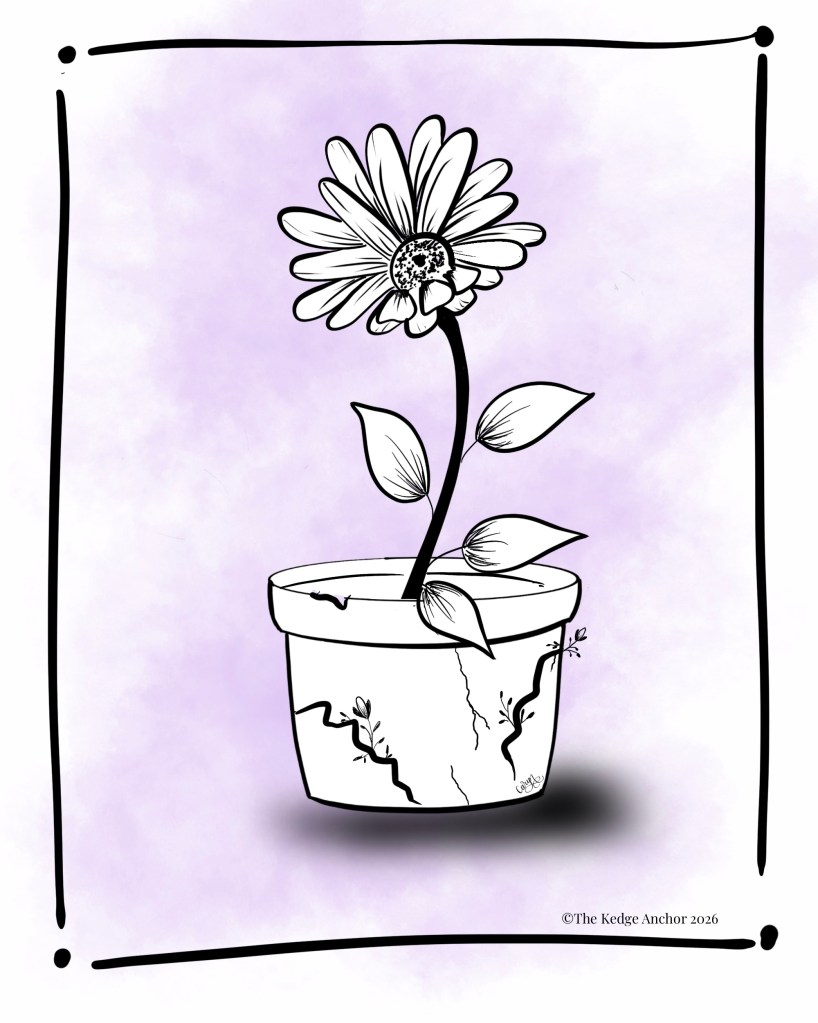
©The Kedge Anchor 2026

Last week, we followed a lump of clay through the hands of a potter.

We watched as the clay was pounded and kneaded, shaped and formed on the wheel, placed on the shelf to dry, and eventually fired in the kiln.

When the potter took the finished piece from the kiln, it was ready for its intended purpose.

But the potter wasn’t finished creating.

He decided he wanted another pot.

This one would be bigger and taller, able to accommodate the flowers bursting from his garden. He wanted it to complement the first pot while adding more contrast to the room with a different shape and color.

The potter began working on the second pot.

He pounded and kneaded the clay, removing the air pockets. Then he placed it on the wheel and began to shape it.

His hands worked the clay, adding pressure and water as he formed it. He opened the center, pulled the clay upward, carefully formed the walls, shaped the lip and smoothed the edges.

When he was satisfied with the shape, he lifted the pot from the wheel and placed it on the shelf waiting for it to dry.

Days passed.

When the pot was completely dry, the potter placed it in the kiln for firing.

After the firing was complete, he waited for the kiln to cool before carefully removing the pot.

It was beautiful.

It was exactly what he had envisioned.

He filled it with flowers from his garden and placed it in the room beside the first pot.

But one day, the second pot was accidentally fell over.

It fell hard.

And it broke.

The potter gathered the pieces.

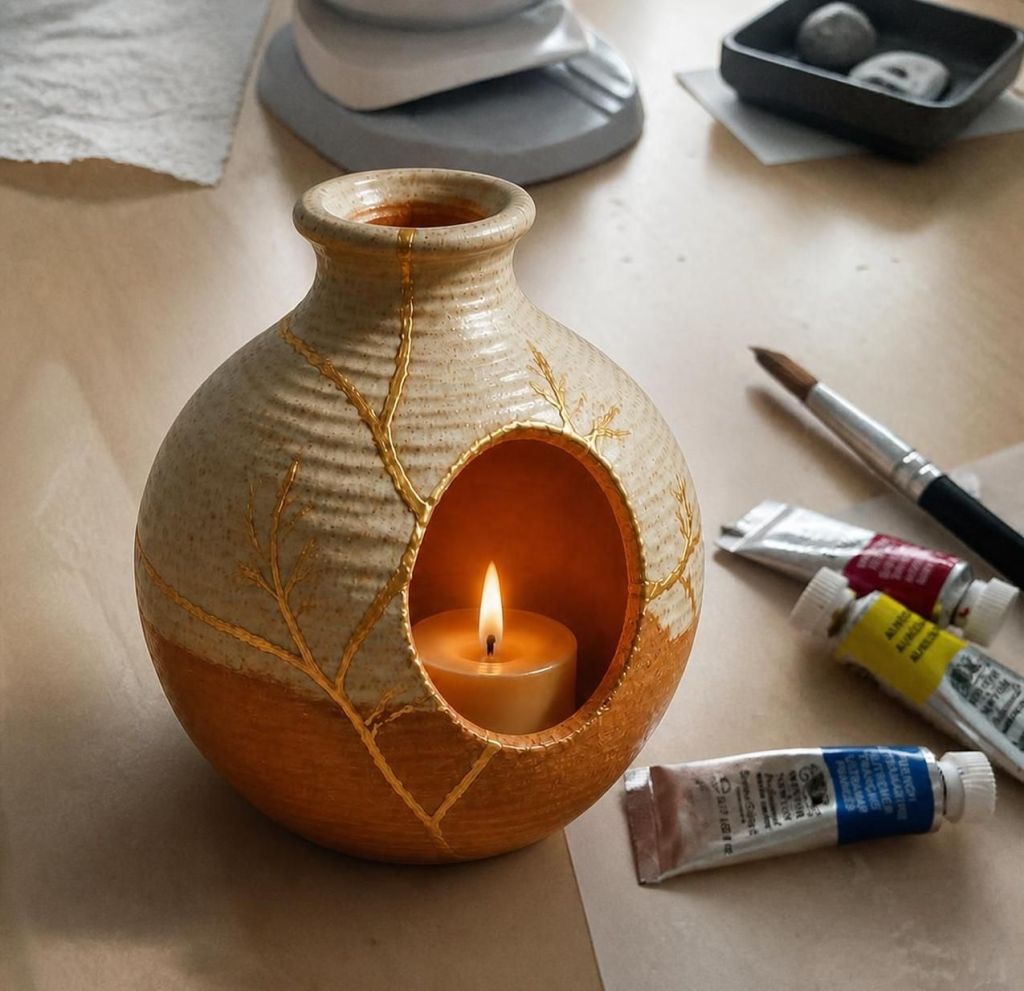
He carefully examined what was left and began putting the pieces back together. Some pieces fit perfectly. Others required more work, a little sanding here and there to smooth some rough edges. He arranged the pieces so that a hole was right in the center.

The cracks from where the pot had broken created beautiful lines. The potter painted those cracks with gold paint and added some leaves, creating a vine that wound its way around the pot. The broken pieces had become part of its beauty.

When he was finished, the pot wasn’t exactly the same as it had been before.

There were places where the broken pieces had changed its appearance. But the potter didn’t see it as ruined.

The candle’s light shone through the places where the pot had been broken and repaired.

The pot had a new purpose.

And perhaps that’s something worth remembering.

Stay tuned for Part 3. There’s more to this story.

encouragement, hope, Stress, Trust God

Navigating Life’s Storms with God’s Word

Lighthouse #2

Ponce Inlet Lighthouse, Ponce Inlet Florida

I have a confession… I shared these posts in the wrong order. 🤦🏻‍♀️

But maybe that’s fitting because we are all still learning and growing. Sometimes even our little mistakes can remind us to slow down, give ourselves grace, and remember that God is still working, even in the imperfect moments.

When was the last time a situation came into your life that you weren’t expecting? Maybe you saw it coming and didn’t know how to stop it. Maybe it was completely out of your control, and there was nothing you could do to change the outcome.

Have you been there?

I know I have.

When storms come into our lives, our first instinct is often to look at the waves instead of looking for the light. We focus on what is happening around us instead of turning toward the One who is steady and faithful.

Part of the story how The Kedge Anchor got its name. Look for the short story on my social media pages,FB and IG

We see this with Peter when he stepped out of the boat and walked on the water toward Jesus. As long as his eyes were on Jesus, he was able to do what seemed impossible. But when he noticed the wind and the waves around him, fear began to take over.

How often do we do the same thing?

We focus on the circumstances around us, the things we cannot control, and all the “what ifs” that fill our minds.

But Jesus is still there, calling us to keep our eyes on Him and to anchor ourselves in Him.

God never asked us to navigate life’s storms alone. He has given us His Word, a light to guide us when we cannot see the way ahead.

God tells us not to worry and to trust Him. And yet, in our humanness, we still worry.

I know I have caught myself getting caught up in a situation, worrying and fretting about things I cannot control. But when I finally stop, take a breath, and turn my attention back to God, that is when I can hear His still, small voice calling me back to Him.

Matthew 6:25 reminds us:

“Therefore I tell you, do not worry about your life…”

And in Matthew 6:34, Jesus reminds us not to worry about tomorrow, because tomorrow will have its own concerns.

God’s Word contains what we need to walk through the storms this life brings our way.

 Psalms 136 remind us of God’s faithful love endures forever. 

Proverbs reminds us:
“Trust in the LORD with all your heart and lean not on your own understanding; in all your ways submit to Him, and He will make your paths straight.” — Proverbs 3:5-6

And the Gospel reminds us of God’s unconditional love for us through Jesus – John 3:16.

I love the promise found in Matthew 28:20:

“teaching them to observe everything that I have commanded you; and lo, I am with you always [remaining with you perpetually—regardless of circumstance, and on every occasion], even to the end of the age.” (AMP). Perpetually. On every occasion. To the end of the age!!!  I love that!!!

Because when a storm hits, our faithful Father should be the first One we turn to.

So today, where are your eyes focused? Are you looking at the waves, or are you looking toward the Light?

encouragement, hope, Trust God

Finding God’s Faithfulness in Creation

Finding reminders of God’s faithfulness in the world around us

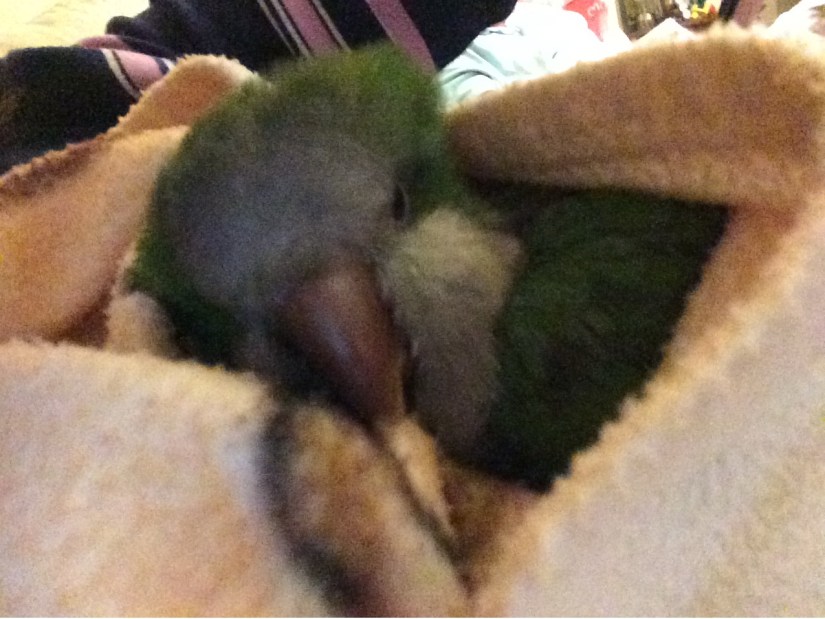
This is Teemu. She was barely a year old in this photo. She’s 28 now.

Have you ever wondered if God sees you? Have you felt like your prayers seem to go unanswered, your circumstances don’t make sense, and you wonder if God is paying attention? You’re not alone. Many of us have been there. I know I have. And that doesn’t mean we don’t have faith. Questions and struggles do not mean a lack faith. But we don’t have to remain trapped in doubt.

Creation reminds us that God is faithful. The birds do not wake up each morning wondering if God will provide. The squirrels in our yards do not worry about where their next meal will come from. They simply do what God created them to do, and He cares for them. Matthew 6:26 – “Look at the birds of the air; they do not sow or reap or store away in barns, and yet your heavenly Father feeds them. Are you not much more valuable than they?” (NIV).

Now, does that mean we will never have worries? Of course not. Job had plenty of worries. He lost his family, his health, and everything he had. He questioned, he grieved, and he struggled to understand what God was doing. But even in the middle of all that pain, Job came back to the truth that God was still in control. God is sovereign.

Job knew what it felt like to question God’s plan. He experienced deep loss and pain, yet even in his questions, he looked at creation and recognized God’s wisdom and power. He said, “Ask the animals, and they will teach you, or the birds in the sky, and they will tell you; 8. or speak to the earth, and it will teach you, or let the fish in the sea inform you.” (Job 12:7-8 NIV).

When we see the birds, the animals, the changing seasons, and all the things He has created, we are reminded that God is faithful. The same God who watches over the smallest creatures also watches over you.

My cuddle bug

Sometimes we want God to explain everything before we trust Him. We want to know the why, the when, and the how. But trust doesn’t work that way. Trust means believing that even when we don’t understand what God is doing, He understands our humanity. He knows our struggles, our questions, and our limitations. But God is still good, He is still present, and He is still in control. He most likely is using the very situation, the very season to draw you closer to Him.

God created the earth, the animals, and us, and He called it all good. He gave us the responsibility to care for His creation. The same God who cares for the birds, the fish, and all of creation cares for us too. He loves us. We are His creation.

So the next time you hear the birds singing or see the squirrels running around, maybe take a moment to remember: the Creator who cares for them is the same Creator who cares for you.

hope, Trust God

Be Careful Where You Put Your But.

Photo by Andreea Andrei on Pexels.com

Have you ever heard someone give you a compliment and then add the word “but”?

“You did a great job, but…”

“I appreciate what you did, but…”

Suddenly, everything before the “but” seems to disappear. One little word has the power to shift our focus from what was good to what was lacking.

I never expected a simple word to teach me something about my faith. But as I started paying attention to how we use the word “but,” I realized it can reveal more than just our communication style—it can reveal where we place our trust.

Because sometimes we do the same thing with God.

“I trust You, but…”

“I know You are faithful, but…”

“I believe You will provide, but…”

Our “but” can become the place where fear, doubt, or the need to control creeps in.

The word itself isn’t the problem. It’s what comes after it. There is a big difference between “God, but…” and “But God…”

One keeps our focus on the obstacle. The other reminds us that God is greater than the obstacle.

Didn’t set out for this post to become a lesson in communication but there is something to be learned here spiritually as well. I was talking with someone a few weeks ago. If I remember correctly the topic was about planning. The person I was speaking with was concerned that not enough planning had been done for something. So I suggested, just trust God it will all work out. The reply was, “Trust God but…” that’s where I had to interrupt. Trust God but. Oooo, that’s dangerous. It sounded like God wasn’t big enough. We have a big God who sees the big picture. We have a God that goes before us and paves a way for us. We can plan six ways to Sunday, we can make all the plans we want BUT GOD, directs our steps. “A man’s heart plans his way, But the LORD directs his steps.” Proverbs 16: 9.

Check out this article.

See how this can be applied spiritually? Man can plan BUT the Lord directs. The “but God” negates whatever we plan. That’s not to say we shouldn’t, we should plan, BUT GOD will directs our steps and provide. And if for some reason if we have done all we think we can do to plan for something, we as humans can forget, we aren’t perfect. God will provide whatever it is we may have overlooked, He will make it work. Because, Romans 8:28 – “And we know that all things work together for good to them that love God, to them who are the called according to his purpose.”

So be careful where you put your “but.” Whether you are giving praise or trusting God for something, stop and think, is going to be “God but…” or “But God…?”

Gratitude, healing, Trust God

When Life Doesn’t Go as Planned: A Journey to Contentment

Sometimes disappointment doesn’t come because something went wrong; it comes because life didn’t turn out the way we imagined. We make plans, imagine our future, and settle into what feels comfortable, only to find ourselves in circumstances we never expected. We wonder how we can find peace when the place, season, or situation we are in doesn’t look anything like what we hoped for.

Recently, I read an article by Karen DelTatto in an email from iBelieve.com that reminded me of my own struggle. Through her own experience of moving into a home and neighborhood that wasn’t what she originally envisioned, she discovered that God’s blessings were not limited to the place she thought she wanted to be. Her story caused me to reflect on my own journey and the places God has planted me along the way.

My husband and I have moved several times throughout our marriage, but Virginia was never a place we imagined calling home. After spending more than 30 years in Florida, leaving was a much bigger adjustment than I expected. It wasn’t because I didn’t appreciate what we had there. I knew how blessed we were. I treasured the warmth, the ocean, the familiar places, the memories we had built, and the life God had given us. That was part of what made the transition so difficult. I wasn’t leaving something I disliked; I was leaving a place that had become home.

I tried to make Virginia feel like home, but there were many moments when I wondered, “Will this ever feel like home?”

But God.

God began to show me blessings I wasn’t always looking for. He provided a wonderful church family and placed people around me who have encouraged me, served alongside me, and reminded me that home is not just a location. He blessed us with great neighbors, and He provided a job for my husband where he is valued and encouraged.

I still miss Florida. I still miss the ocean, the warmth, and the familiarity of a place where we had built so many memories. If I am being honest, I can’t say I love Virginia the way I loved Florida. But God is teaching me that contentment does not mean we love every circumstance we are in. Contentment means trusting that God is present in every circumstance.

As I reflected on Karen’s story, I was reminded that sometimes the place we don’t choose is the very place where God is working. She discovered blessings in the neighborhood she didn’t originally want, and I am learning to recognize blessings in the place God has brought us.

This also made me think about Paul. His circumstances were far beyond anything I have experienced. Prison was not where Paul planned to be, yet from that place he wrote words that continue to challenge us today:

“I have learned in whatever situation I am to be content.” — Philippians 4:11

Paul didn’t find contentment because his circumstances were easy. He found contentment because he knew God was with him.

I am still learning contentment. I still miss Florida, but I am learning that my peace cannot be anchored in a location. My peace is anchored in Christ.

What about you? Have you ever found yourself in a place or season you didn’t choose, but God showed you blessings you didn’t expect? I’d love to hear what He taught you. Leave a comment below.

anxiety, Fear, Obedience

How to Please God: Lessons from the First Day of School – Part 1

Photo by Atlantic Ambience on Pexels.com

There was always a feeling of anxiousness going back to school. That first day was always rough. Sometimes I’d hear rumors of how hard my homeroom teacher was going to be and stories from other students the nightmare that homeroom class was for them the year before.

It was always nice to be a little early and see some old friends and kids I hadn’t seen all summer, for a brief moment I would forget about being anxious. Then the bell would ring and all the students would walk into their classrooms. I’d be anticipating the teacher walking in or if the teacher was already there, I’d be accessing his or her mood.

I was always afraid that I would accidentally break a rule, make the teacher mad and send me to the principal’s office get detention and then when I got home, be reprimanded again. But isn’t that just like us humans to catastrophize everything, even as kids.

My goal was to do well in school, make my teacher and parents happy, make some friends and have some fun. But I still had this fear and worry I would do something wrong. I didn’t want to make my teacher mad or break a rule. I lived in fear those first few days of a new school year.

As a Christian, now, all I want to do is love God and obey His word. But I have to admit if I have the wrong perspective, I can live in fear of God. We are to have a reverent fear, an awe of God. Proverbs 1:7 – “The fear of the LORD is the beginning of knowledge: but fools despise wisdom and instruction.” I do have a reverent fear of God. He is in control, He is omniscient, omnipotent, and omnipresent. He is sovereign and righteous. Jeremiah 32:17 – “Ah, Sovereign LORD, you have made the heavens and the earth by your great power and outstretched arm. Nothing is too hard for you.”

All I want to do is please God, every day. But I know I am a sinner and I can’t be perfect. God sacrificed His Son to die for us and pay the penalty of sin, so that we can live with Him forever in eternity. Now if someone saved me from a burning building, rescued my from a sinking ship, whatever, I would be forever grateful to that person. I would welcome that person into my life as part of my family, I would stay in contact and give back however I could. The same is for me with God. He saved me from death and gave me eternal life and all I had to do was accept Him and receive the gift of salvation. He is my life, I stay in constant contact and try to give back when I can however I can.

So how do I please God? What can I do to make Him happy? After all it’s only His approval I seek. It’s only His approval that matters. Like the first day of school, I live in awe of God and sovereignty. Unlike the first day of school, I don’t have any anxiety about making a mistake or making God mad. But I began to think, what does make God happy? What do I do to please Him?

I want to obey His word, His commandments. God gave us His word, the Bible. It contains everything we need to know about Him and how to live for Him. But what is that exactly?

The Ten Commandments were the first set of guidelines to live by. After Jesus came to the earth, He narrowed those down to two. Matthew 22:37-40, “Jesus said unto him, Thou shalt love the Lord thy God with all thy heart, and with all thy soul, and with all thy mind. This is the first and great commandment. And the second is like unto it, Thou shalt love thy neighbour as thyself. On these two commandments hang all the law and the prophets.“ Ok so there’s two. That’s not all.
Here are some other things I have found.

Philippians 4:6-7 – “Do not be anxious about anything, but in everything by prayer and supplication with thanksgiving let your requests be made known to God. Outside of the fact God is telling us not to be anxious (Do not be anxious, I believe that is in command form, He’s not suggesting, He’s telling us not to be anxious. Easier said than done, that’s a discussion for another time). So God wants us to communicate with Him about everything always.

Hebrews 11:6 – “ And it is impossible to please God without faith. Anyone who wants to come to him must believe that God exists and that he rewards those who sincerely seek him.” and faith cometh by hearing and hearing the word of God, Romans 10:17

1 Thessalonians 5:17 – “Pray without ceasing.” Just exactly what that means. But prayer and talking to God isn’t always bowing our heads and folding our hands. (Another discussion for anther time).

1 Peter 4:9 – “Be hospitable to one another without complaint.” Being hospitable, that’s easy, without complaint, not always easy.

Proverbs 3:9 – “Honor the LORD with your wealth, with the firstfruits of all your crops;” Your wealth may not be thousands of dollars in the bank. God just wants you give back and mange what He has given you.

James 4:8 – “Draw near to God, and he will draw near to you. Cleanse your hands, you sinners, and purify your hearts, you double-minded.”

Romans 14:17-18 – “for the kingdom of God is not eating and drinking, but righteousness and peace and joy in the Holy Spirit. For he who in this way serves Christ is acceptable to God and approved by men.

There are so many more ways we can please God, and this post is already getting long. I think this is a topic I will continue exploring.

Looking back, I realize I spent so much time worrying about disappointing my teachers, breaking a rule, or making a mistake. But God is not waiting for us to mess up so He can punish us. He wants us to learn, grow, and draw closer to Him.

Yes, we should have a reverent fear of God because He is holy and sovereign. But we also have the incredible privilege of knowing Him as our loving Father.

Just like the first day of school, we may feel nervous stepping into a new season. But unlike those first days in the classroom, we don’t have to walk in afraid. God walks with us, teaches us, and guides us.

What are some things you have found in Scripture that show us how to please God? I’d love for you to share in the comments.

Stay tuned for Part 2 tomorrow.