art, hope

Design for Life: Alignment — Who’s at the Center?

Art definition: “…it’s the foundation upon which your design stands and appears attractive to the viewers…Alignment refers to the arrangement of different design elements on various positions. Alignment declutters the design and frees it from becoming a disorderly chaos. Believe me; no one likes a design with scattered text and misaligned graphics. It’s the worst design sin anyone can commit!” (https://www.designmantic.com/blog/art-of-alignment-graphic-design
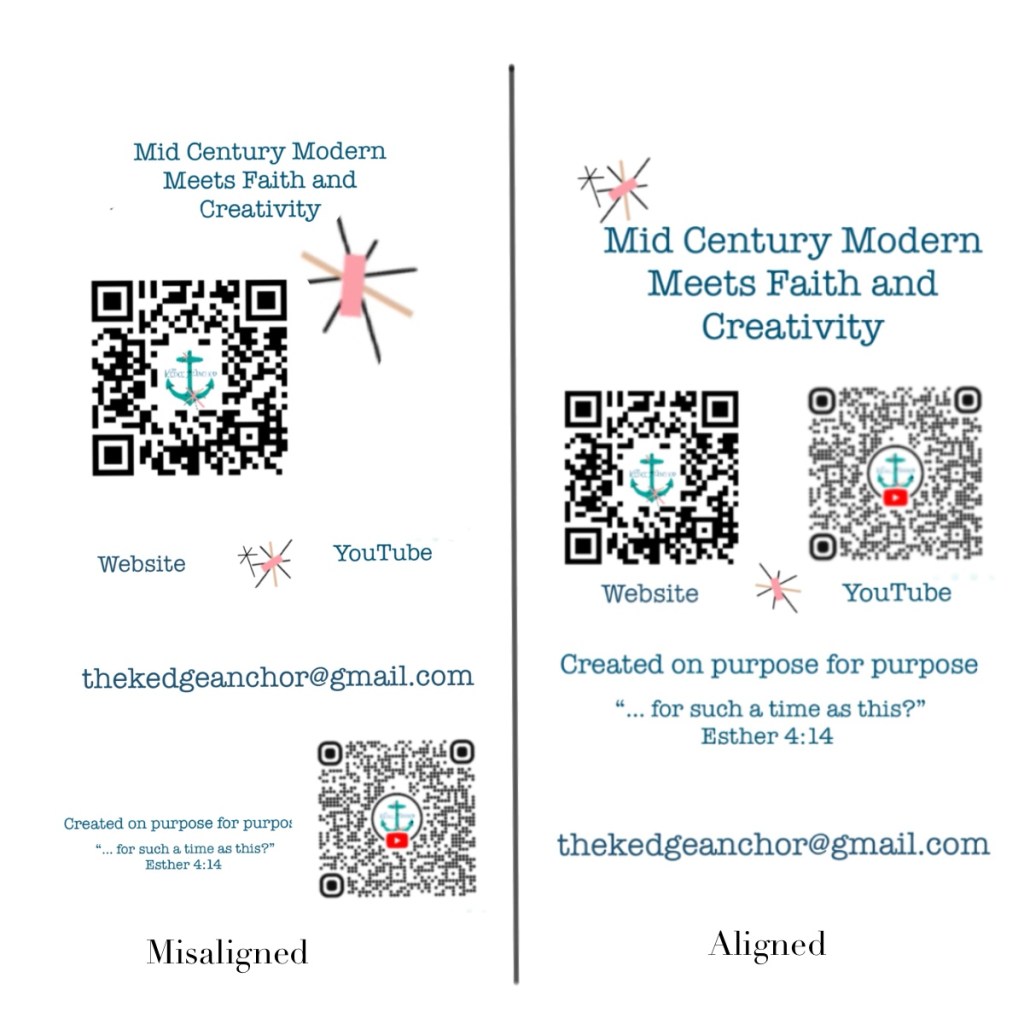
The same information, two different layouts. The card on the right uses consistent alignment to create order and visual flow, while the card on the left shows how shifting elements can disrupt that flow.

When we aren’t aligned with God our lives can become chaotic and disorganized. Not that that is a sin.  I like how this definition states, “Alignment declutters the design and frees it from becoming a disorderly chaos.” I am sure it’s a pleasing sight to God when we are in alignment with Him.

There are four ways to align objects, elements and text in a piece of art.

Center

Justified

Right flush

Left Flush

But when we talk about spiritual alignment – there is only one way – center alignment. To put God at the center of everything. So how do we align ourselves with God? What does it look like and what happens when God is the center of our lives?

Let’s look at what the Bible tells us about alignment. Matthew 6:33 tells us “Seek ye first the kingdom of God…” In Exodus 20:3 we read “Have no other gods before me.” What does this look like in practice? It could be:

– Reading and spending time in God’s word

– Prayer

– Serving, our families, community, church

– Tithes and offerings

  • Using our gifts and talents for God’s Kingdom Obedience
  • Encouraging others

There was a point and there are times where I felt like and feel like my prayers are hitting the ceiling. I begin to wonder if God is hearing me? Why isn’t He answering me. When that happens, I stop and evaluate. What am I doing or not doing? If I am spending time with God and my prayers still aren’t being answered, what gives? It’s not only to whom I am praying but what am I praying for. Are my prayers self centered? Often, I find that what is missing is that I need to pray His will.  “Our Father who art in Heaven hallowed be thy name, thy kingdom come, thy will be done …” I realized I need to pray His will for my prayers to be answered. I needed to align myself with His plan (whatever that is) for me, for others, for the future.

Mike Donehey wrote a book, Finding God’s Life for My Will. I highly recommend reading this book if you are struggling with God’s plan for your life.  I like what he had to say about being successful. “God doesn’t want our success, He wants our surrender.” Whoa. We can align ourselves by making God the center of our lives, by surrendering ourselves, our plans, our desires to Him. We don’t have to work at being perfect, we don’t have to perform, we don’t even have to try. We don’t have to be successful.

And to answer the second part of the first question, what happens when we are aligned? “Seek ye first the kingdom of God And His righteousness And all these things shall be added unto you Allelu, alleluia” maybe you’re familiar with the song?

All these things being, rest, order, joy, peace, fruits of the spirit. Our lives can become free of disorderly chaos. God will also provide our needs. Matthew 6:31-34 tells us that our Father knows all that we need before we do. He tells us not to worry about tomorrow. He will provide as He provides for the birds and we are worth more to Him. His will for us is to be aligned with Him. He is the plan. If we are aligned with Him and we trust Him, we will begin to pray His will and He will lead us to take those steps of faith as Joshua and the Israelites did at the Jordon.

Reflection

What step of faith might God be calling me to take right now, even if I don’t have all the answers.

What is currently at the center of my life?

In what areas of my life do I feel cluttered or in chaos?

How might misalignment be contributing to that chaos?

Let’s reflect together. What stood out to you today? Share in the comments.
art, Design for Life, hope

Design for Life: When Art Meets Faith

What if the principles that make a work of art beautiful could also teach us something about how we live our lives?

Our Heavenly Father is the Master Artist, the Creator of all things. From the smallest living creature to the vastness of the universe, His creation reveals purpose, order, and incredible detail.

John 1:1–3 reminds us that all things were made through Him. Even the materials we use to create art, pigments from the earth, paper from trees, and fibers from plants come from what God has already created.

And what about us? Psalm 139:14 declares that we are fearfully and wonderfully made. Like a potter shaping clay, God forms each of us uniquely. We are not mass-produced or interchangeable. We are His creation, each with our own gifts, experiences, and purpose.

But God’s design for humanity didn’t end with creation. He knew sin would enter the world, and His plan of redemption was already in place. Through the death and resurrection of Jesus Christ, He made a way for us to be reconciled to Him and look forward to eternal life.

God has a design for life—and He has given us principles to help us live it.

In art, design principles are guidelines that help us create visuals that communicate effectively. But what if we looked beyond the canvas and applied those same principles to our walk with Jesus?

Throughout the Gospels, Jesus taught His followers how to live differently from the world around them. His instructions challenged their priorities, attitudes, and behavior. That makes me ask myself: What sets my life apart? Am I living in a way that reflects Christ, or am I simply blending in with the world?

That’s what this Design for Life series is about.

Here on The Kedge Anchor, we’ll explore how principles of design can offer meaningful illustrations for our walk with God. Art can teach us to see things differently. My hope is that this series will help us see our faith and the way we live it in a new light.

Let’s discover how the principles of design can point us toward a life designed to reflect Him.

encouragement, healing, hope

When Life Doesn’t Go as Planned: The Potter and the Clay — Part 2

What Do We Do When Life Doesn’t Turn Out How We Expected?

©The Kedge Anchor 2026

Last week, we followed a lump of clay through the hands of a potter.

We watched as the clay was pounded and kneaded, shaped and formed on the wheel, placed on the shelf to dry, and eventually fired in the kiln.

When the potter took the finished piece from the kiln, it was ready for its intended purpose.

But the potter wasn’t finished creating.

He decided he wanted another pot.

This one would be bigger and taller, able to accommodate the flowers bursting from his garden. He wanted it to complement the first pot while adding more contrast to the room with a different shape and color.

The potter began working on the second pot.

He pounded and kneaded the clay, removing the air pockets. Then he placed it on the wheel and began to shape it.

His hands worked the clay, adding pressure and water as he formed it. He opened the center, pulled the clay upward, carefully formed the walls, shaped the lip and smoothed the edges.

When he was satisfied with the shape, he lifted the pot from the wheel and placed it on the shelf waiting for it to dry.

Days passed.

When the pot was completely dry, the potter placed it in the kiln for firing.

After the firing was complete, he waited for the kiln to cool before carefully removing the pot.

It was beautiful.

It was exactly what he had envisioned.

He filled it with flowers from his garden and placed it in the room beside the first pot.

But one day, the second pot was accidentally fell over.

It fell hard.

And it broke.

The potter gathered the pieces.

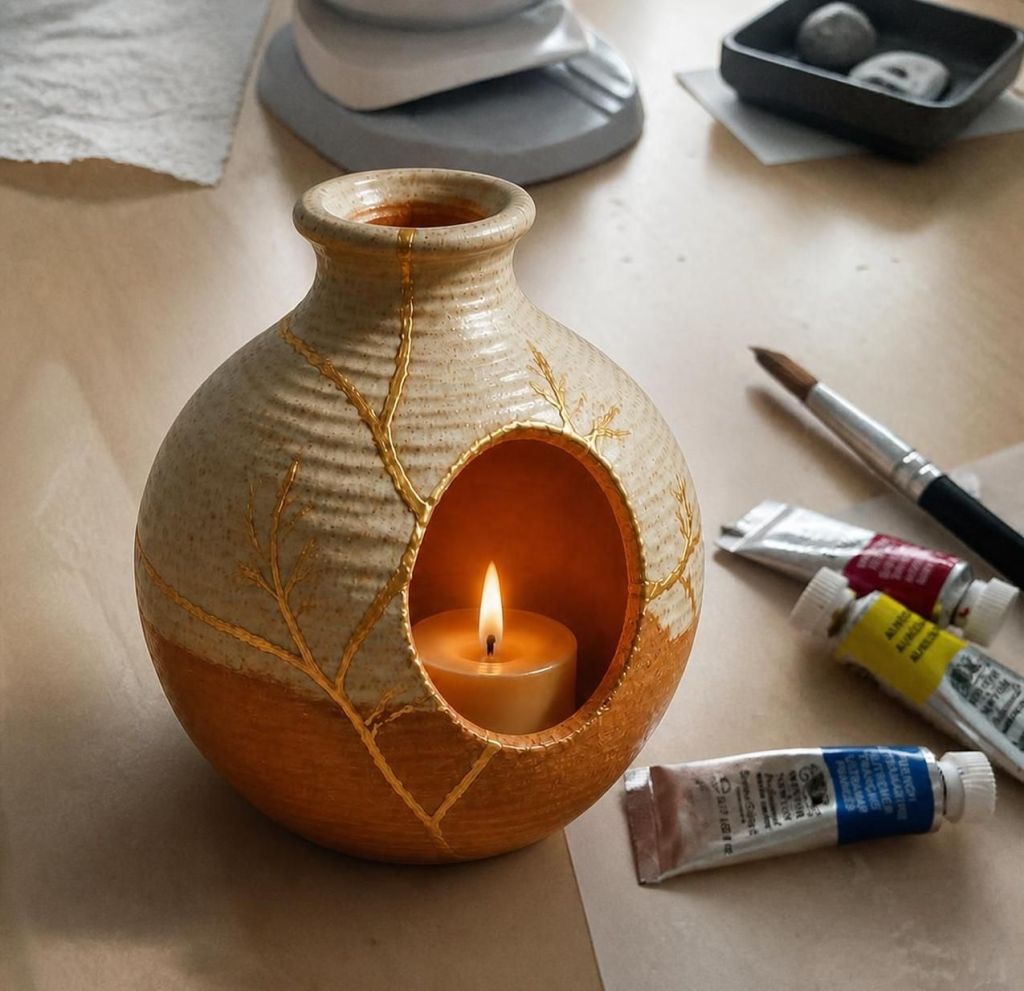
He carefully examined what was left and began putting the pieces back together. Some pieces fit perfectly. Others required more work, a little sanding here and there to smooth some rough edges. He arranged the pieces so that a hole was right in the center.

The cracks from where the pot had broken created beautiful lines. The potter painted those cracks with gold paint and added some leaves, creating a vine that wound its way around the pot. The broken pieces had become part of its beauty.

When he was finished, the pot wasn’t exactly the same as it had been before.

There were places where the broken pieces had changed its appearance. But the potter didn’t see it as ruined.

The candle’s light shone through the places where the pot had been broken and repaired.

The pot had a new purpose.

And perhaps that’s something worth remembering.

Stay tuned for Part 3. There’s more to this story.

hope, Trust God

Be Careful Where You Put Your But.

Photo by Andreea Andrei on Pexels.com

Have you ever heard someone give you a compliment and then add the word “but”?

“You did a great job, but…”

“I appreciate what you did, but…”

Suddenly, everything before the “but” seems to disappear. One little word has the power to shift our focus from what was good to what was lacking.

I never expected a simple word to teach me something about my faith. But as I started paying attention to how we use the word “but,” I realized it can reveal more than just our communication style—it can reveal where we place our trust.

Because sometimes we do the same thing with God.

“I trust You, but…”

“I know You are faithful, but…”

“I believe You will provide, but…”

Our “but” can become the place where fear, doubt, or the need to control creeps in.

The word itself isn’t the problem. It’s what comes after it. There is a big difference between “God, but…” and “But God…”

One keeps our focus on the obstacle. The other reminds us that God is greater than the obstacle.

Didn’t set out for this post to become a lesson in communication but there is something to be learned here spiritually as well. I was talking with someone a few weeks ago. If I remember correctly the topic was about planning. The person I was speaking with was concerned that not enough planning had been done for something. So I suggested, just trust God it will all work out. The reply was, “Trust God but…” that’s where I had to interrupt. Trust God but. Oooo, that’s dangerous. It sounded like God wasn’t big enough. We have a big God who sees the big picture. We have a God that goes before us and paves a way for us. We can plan six ways to Sunday, we can make all the plans we want BUT GOD, directs our steps. “A man’s heart plans his way, But the LORD directs his steps.” Proverbs 16: 9.

Check out this article.

See how this can be applied spiritually? Man can plan BUT the Lord directs. The “but God” negates whatever we plan. That’s not to say we shouldn’t, we should plan, BUT GOD will directs our steps and provide. And if for some reason if we have done all we think we can do to plan for something, we as humans can forget, we aren’t perfect. God will provide whatever it is we may have overlooked, He will make it work. Because, Romans 8:28 – “And we know that all things work together for good to them that love God, to them who are the called according to his purpose.”

So be careful where you put your “but.” Whether you are giving praise or trusting God for something, stop and think, is going to be “God but…” or “But God…?”

Uncategorized

Finding God in the Chaos: A Journey Beyond Devotionals

I almost didn’t start this.
Not because I don’t have anything to say—but because everything I see online feels like noise.
“Do this.” “Try that.” “The one simple thing to fix your focus.”
Devotionals. Study plans. Hacks. Step-by-step guides.
And I get it—some of it helps. But lately, it’s felt like too much.
Life with God hasn’t felt neat lately. Not bullet points. Not systems. Not quick fixes.

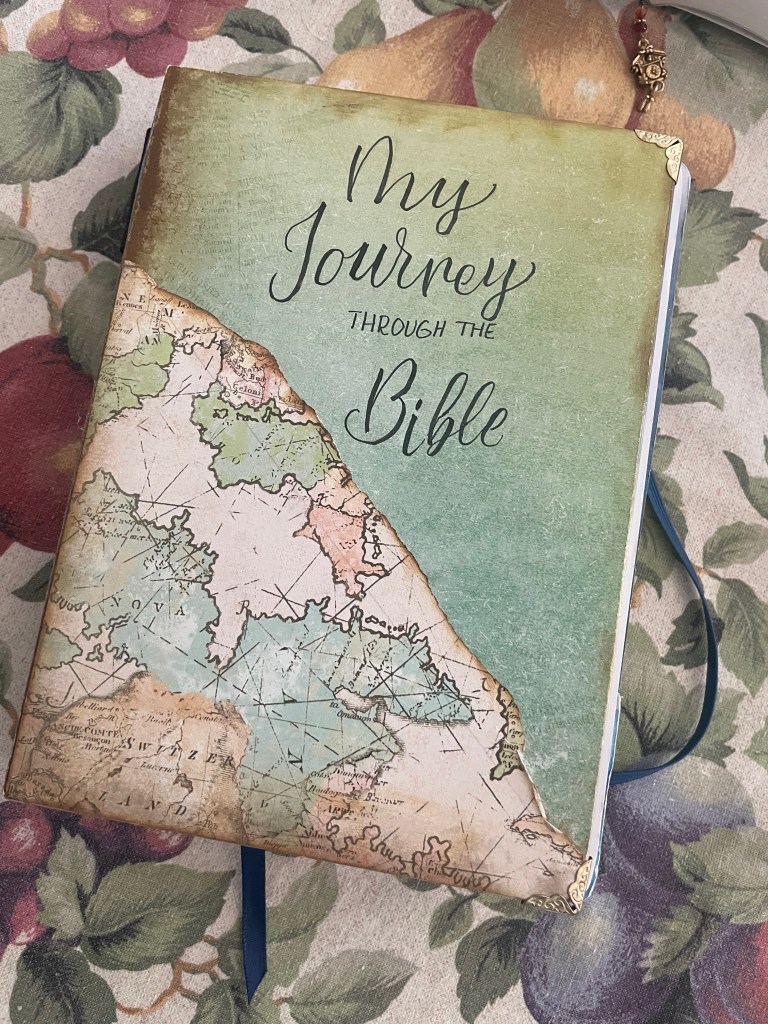
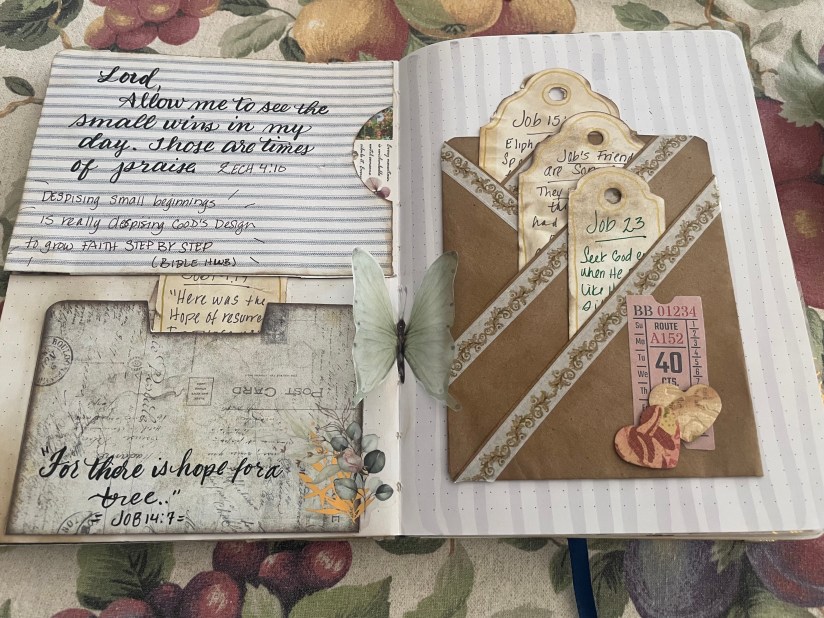
I ditched the devotionals and started reading the Bible in chronological order. I’ve also been taking my time, sticking to a reading plan and journaling in a junk journal sort of way. Visuals help me remember and recall.
That’s the only devotional I really need.
Not that I’m knocking devotionals—they can be helpful—but there’s only one voice I really want to hear: God’s.

So this isn’t another “how-to.”
It’s just me showing up, sharing what I’m walking through, and what I’m holding onto in the middle of it.
Some days it will be clear. Some days unfinished. Most days somewhere in between.

If you’re trying to stay grounded without needing another system… you’re not alone.
I’m just trying to stay anchored. That’s it.

PS: If you want to read along as I figure this out, you’re welcome to subscribe. No pressure, just showing up together.


encouragement, hope

Guidance on Voting: Moral Choices in Politics

For the past few weeks, I have been struggling with the phrase- “choose the lesser evil.” No one wants to choose evil. Oftentimes we are caught between a rock and a hard place. There are times we are faced with dilemmas and there doesn’t to appear to be a good choice. What are we to do?

Photo by Sora Shimazaki on Pexels.com

Hearing the quote, “choose the lesser evil” leaves me feeling hopeless and discouraged. I don’t want to choose evil especially in this political climate…it’s enough to make me shut down. Though we have choices, Republican, Democrat, other or don’t vote. To some the choice is clear, to others the choice may seem murky. If choosing the lesser of evils is still evil, we’re in one of those tight spots.  

  Many feel politics doesn’t belong in the church. Perhaps, but if we can’t turn to our pastors or our churches who can we turn to when we have questions especially sensitive ones such as how do we vote? Who else can help guide us when we are between a rock and hard place? And that’s not to say a church or a pastor can tell you how to vote, but they should be a resource for those times when you are faced with a tough decision. When it comes to making a moral decision, the Ten Commandments are a perfect way help make those decisions. And I do believe the Ten Commandments can help us with how to vote. I am not telling you how to vote. But if you are on the fence I hope this blog post can help you maybe help you with another tough decision.

I wish more pastors and churches would speak about those sensitive subjects such as voting, abortion, suing, politics and current issues. These may not have a place in our churches and pastors can’t tell you how to choose, that is the conviction of the Holy Spirit. However, these topics do exist in our society that we interact with daily and we as Christians should know how to respond. Turning to scripture should be the our first line of defense against these tough choices. We should also be able to go to our pastors for guidance, not to justify our thinking or not but to help us with reading scripture. God gives us the Ten Commandments, it’s His moral law. And I believe when we are in a tight spot, when we are confronted with a dilemma we can turn to God’s word for direction and conviction.

            We are all sinners and there is not a perfect politician on the planet and if they are all evil, who are we supposed to vote for? “Choose the lesser evil” is not Biblical. I found a few articles that helped me understand this more. One article I found; “Is the Lesser of Two Evils a Biblical Principle” makes some great points. In Daniel 2:21-22 “He changes times and seasons; he deposes kings and raises up others. He gives wisdom to the wise and knowledge to the discerning. 22 He reveals deep and hidden things; he knows what lies in darkness, and light dwells with him” (NIV). God is sovereign. We can see this in Genesis 50:20 “You intended to harm me, but God intended it all for good. He brought me to this position so I could save the lives of many people“ (NIV). Joseph’s brothers meant to kill him but God used that so Joseph could save his family from the famine.

              The article goes on to say that God will use and control even the most wicked rulers for his purpose as we see in the book of Daniel. David was a man after God’s own heart even though David was an adulterer and a murderer, but yet God used him, he even used Pharaoh.

             As I was initially pondering, this, I heard God say; “Evil is not in the eye of the beholder.“ Sin is sin in God’s kingdom. There is no lesser evil in God’s eyes. The article sheds some light on our dilemmas in life by looking at what evil might look in the eyes of God, 

 Hosea 6:6 – “For I desire steadfast love and not sacrifice, the knowledge of God rather than burnt offerings. (ESV)
Micha 6:8 -“No, O people, the LORD has told you what is good, and this is what he requires of you: to do what is right, to love mercy, and to walk humbly with your God.” (NLT)
Matthew 9:12-13 – ”Go and learn what this means: ‘I desire mercy, and not sacrifice.’ For I came not to call the righteous, but sinners.” (ESV)

“Meaning, I would rather you do good than offer your sacrifices. This, during the time when sacrifices, was the law of the day. God says, “I would rather you do right — to show mercy, and act justly.” (quote article)

  “Jesus taught us that healing people or allowing them to eat were acts of love and clearly overruled the written law — and so, on his terms, not sin, since Jesus never sinned.”

    When we are faced with tough choices, there is no level of evil. We must choose what is good, the right thing. “To not act in love may be the true evil in the eyes of God.” This gave me hope and helped me to change my mindset when I need to make a tough choice.

References:

The Lesser of Two Evils Principles – Myth or Biblical

Should Christians Vote for the Lesser of Two Evils

Uncategorized

The Meaning of Ohana: God’s Design for Community and Family

Photo by Tru1ea7n Long on Pexels.com

I may be dating myself a bit, but every time I think of luaus or Hawaii, I think the Brady Bunch episodes where the Brady’s tag along with their dad to Hawaii on a business trip. At the time, the Brady’s weren’t recognized as a blended family. But, that is indeed what they were. A widow with three girls and a widower with three boys that’s how “we became the Brady Bunch.” If you know, you know.

The Hawaiian word for family is Ohana, it can also mean community. God created us for community, we weren’t meant to do life alone. God gave Adam, Eve, In Genesis 2:18, said “it’s not good for a man to be alone.” Jesus had a blended family, having step brothers and sisters, His disciples are a another example. They traveled together, they shared meals together, they did ministry together. Just as the Brady’s were a blended family, there are other versions of blended families today, some have step parents and step siblings like the Brady’s, some have half siblings, there are foster families, our co-workers can be like a family and our church is definitely a family.

There are several other examples of families in the Bible. Naomi and Ruth is a good example that comes to mind. If you’re not familiar with their story I encourage you to read the book of Ruth and see how God brought them together and provided for them. It’s not that long and if you’re up to it read a commentary.

A little background, Naomi had a husband and two sons and lived in Bethleham, until a famine hit when they traveled to the foreign land of Moab. Only for Naomi to lose her husband. Her sons both both married Moab women, Ruth and Orpah. About ten years later Naomi’s die.

These three woman are now without husbands and are childless. These are good circumstances for these women. Back in their day, Naomi, Ruth and Orpha would have returned to their hometowns, their own people. Orpha remained with her people in Moab, but Ruth remained loyal to her mother in law and went back to Bethlehem with her. Ruth 1:16 – “But Ruth said, “Do not urge me to leave you or to return from following you. For where you go I will go, and where you lodge I will lodge. Your people shall be my people, and your God my God.”

Naomi and Ruth were once connected by Naomi’s sons, now they were connected by God and His people. We may come from different parts of the country, of the world, we may come from a different culture but as a followers of Jesus it’s His blood that connects us and makes us family, makes us Ohana.

I want to be sensitive to the fact that not everyone has a family, for whatever reason. Many experience loneliness on a daily basis. They don’t have anyone to connect with or to. But, when we become a part of God’s family we have the opportunity to build genuine, loving, lasting relationships through Jesus, He connects us, He connects us with and to God, our Heavenly Father, who forgives us and gives us eternal life.

When we have family and friends we have one of God’s blessed and precious gifts, because we were meant to live in community. Having God’s people as our people, we can have a support system we can count on when we need prayer, encouragement on hard days and the opportunity to be blessed by serving God’s people. One way we can connect with God’s people is by attending a local Bible believing church, getting involved and sharing our faith with each other and unbelievers.

The best connection is with God Himself who promises eternal life when we repent of our sins and promises to never leave us or forsake us. Being a part of God’s people we will always have family.

Leave a comment below how you have been blessed by God’s people.

hope

He Is Risen! – Free Coloring Page

Happy Easter Sunday! Jesus is risen, He is alive!!!

Uncategorized

Free Coloring Page – Good Friday 2024

Happy Friday and Good Friday. Although it wasn’t so happy or good for Jesus. So why is it called Good Friday? Jesus was innocent, yet He was crucified for the sins of the world. He endured pain for us. We are the ones who deserve what Jesus went through. But the cross gives us Hope. Sunday is coming!!

If you haven’t seen today’s blog post please take a few minutes to watch.

Here is another free coloring page to help remind and reflect why today is called Good Friday.

art

April – National Greeting Card Month

Like “video killed the radio star” the digital age killed hand written letters and cards. Sending greeting cards is becoming such an old way of communicating. It’s a shame because it’s such a personal way to show someone how much you care. The only real downside of sending a greeting card or letter is the fact it has to be mailed. Texting, messaging and emailing are quicker, more real time it can lack personality. Ok sure you can apply an emoji or a “sticker” (and I loved stickers growing up) to give your digital message more personality, but then again everyone is using them, the same ones.

Greeting cards are getting expensive. It is far less costly to send an email or a text or post a birthday greeting on a Facebook page. Hand crafting a greeting card can be much more rewarding. It doesn’t need to be elaborate, it can be simple. How many times have you poured over the greeting cards at a store looking for the right one with the right sentiment? By crafting your own card it you can write exactly what you want to say. I can hear you saying “that’s hard” “I’m not a writer.” You don’t have to be.

I have been making greeting cards since I was old enough to hold a crayon. I can remember making birthday cards for my mom and dad, their birthdays were pretty close together. My mom used to sew on occasion, so I took some fabric scraps and construction paper and cut out an apron with a little pocket and added a bow. For my dad I cut out a shirt with a tie. I glued the fabric to the construction paper and voila I had a greeting card. Genius, lol. My greeting cards have advanced a little since then.

Journey with me the month of April with learning the history of greeting cards, hand writing, and greeting card tutorials.