
hope

Waiting on God: Strengthening Faith Through Patience

Waiting on God can feel slow, heavy, and confusing but the Bible shows that “waiting” is one of the most powerful spiritual practices we have that is often perceived as an inconvenience. In Scripture, the words for wait in Hebrew and Greek go deeper than simple patience; they are defined by expectancy, hope, perseverance, and a deep trust.  The Bible often pairs hope with waiting. The Hebrew words for “hope”—qavah and yakhal—are often translated as “wait,” describing patient, trust. We attend to God’s promises, remember his track record, and let that memory strengthen our expectations. The psalmist waited for God “more than watchmen for the morning” (Ps. 130:6). The apostles spoke of a “living hope” anchored in the resurrection of Jesus and the renewal of all things (1 Pet. 1:3). 

Waiting has a way of stretching us. It has a way of producing patience, which is a fruit of the Spirit. – Galations 5:22-23. The Hebrew word is Qavah -waiting with tension., to wait with an expectant tension, like pulling a rope tight. (Isaiah 40:31). God isn’t asking us to sit still and do nothing. He’s inviting us to lean into Him, trusting that strength is being woven into us as we do. Waiting can be the spiritual act of being pulled together, not pulled apart. Like God is tugging on the loose threads of our hearts, pulling them taut so He can weave something stronger in us.

When it comes to waiting on the Lord, the time is never wasted. God is intentional about the pauses He gives us. Biblical waiting is never passive. It is one of the most active spiritual postures there is. The Bible uses several descriptive Hebrew and Greek words for “wait,” and each one peels back a layer on what God is doing in the quiet seasons of our lives.

A few days ago I started a devotional plan on the Bible app – Anticipating Christmas – An Advent Overview. It was this paragraph that struck a cord -“Over the next four days, we will walk through the key Advent themes of hope, peace, joy, and love. Each one reveals an aspect of God’s character and calls us to live in light of the world he is making. Between the first advent and the second advent, Jesus’ return, our lives take their shape from the story God is telling.”  “Between the advents” is what caught my eye.

(Side note:the words I highlighted, hope, peace, joy are three words I felt the Holy Sprit gave me for 2026. And now I believe He’s tossing in the word wait.)

Whilst I was reading the first day of this devotional plan, I couldn’t help but think about what was prophesied in Isaiah about Jesus’ birth, His first arrival to earth and His return.  I have to be honest, the world is craaaaaazzzzeee right now. None of which has taken God by surprise, however, I never thought or imagined in a zilllion years the events of evil, lies and division that has taken place over the past few decades, much less past few years. I ask God often, “How much longer? How bad is it going to get before Jesus meets us in the clouds?” At which point, I realize, I really don’t want to know.  I just know that things aren’t going to get any better until Jesus returns to the earth again. The world waited, like 700 years from the time of the prophesy in Isaiah to the birth of Jesus. It’s been over 2000 years since Jesus gave His life and shed His blood for us on the cross. And with all that’s going on… I can’t help but be aware of Christ’s return. (Read the book of Daniel if you want a time line of the events that have already taken place). 

Waiting is hard. Well, it is for me sometimes, ok most times. Sometimes I enjoy and appreciate the anticipation. Sometimes there’s anxiety in the wait, sometimes it’s pure excitement, sometimes I can wait patiently. What matters most is what I am doing in the wait? Which made me think of another devotional I read about the virgins waiting for the bride groom and tied into the sermon my pastor spoke on a few Sundays about waiting and things started to merge. Yep, waiting is a word for 2026. 

So I am mainly focused on waiting for Jesus to open up the sky and meet us in the clouds. What do I do, we do, whilst waiting for His return. 

Ok back to the ten virgins who were instructed to keep their wicks trimmed and lamps full of oil. The trimming of the wicks – important because for the oil to burn efficiently and clean, otherwise the oil would burn faster and be smokey. To me that symbolizes trimming the things that will cloud my focus on waiting, specifically for Jesus’s return. Maybe I need to trim my time on social media or say no to things that will overload my schedule and cloud my focus on God.

Keeping my lamp fill with oil symbolizes staying filled with the Holy Spirit. I can only do that by staying in close proximity to God, reading His word daily and serving Him. In order to keep something filled, we have to keep an eye on it. For instance to keep gas in your car you need to pay attention to the gas gauge. In waiting for Jesus’s return we have to keep our eyes opened, minds alert ready to hear Jesus (Psalm 130:6 – more than a watchman waiting for morning). Keeping our lamps full we are preparing by storing scripture in our hearts. See waiting isn’t passive. I guess I need to be aware of what I am doing when I am waiting. I can be passive or active in my waiting and focusing on God and serving Him are a few ways I can actively wait for Jesus to meet us in the clouds..

This could be applied to waiting for anything God has you waiting for. I can also apply this to everyday waiting and be more productive by choosing to spend less time on social media in my waiting and read something or maybe sketch or take time to memorize a verse. Are you waiting on an answer from God? What are you doing in your wait? Are you staying active and waiting with expectant hope?  Keep you lamp full and your wick trimmed. Keep your heart and mind focused on God, His word, recall the the times He has been faithful to encourage you and remind you.

Waiting is never wasted when you are waiting on God and serving Him in the wait and there are so many ways to serve Him. The hope that comes with waiting faces the dark and keeps watch. It acknowledges the difficult season without surrendering to it. There are things we can do in our spiritual wait and our everyday waiting. Practice waiting this week. When anxiety rises, pause and remember a moment of God’s faithful care. When you’re tempted to grasp for control, choose a small act of trust, cast your cares (1 Peter 5:&7). Hope and faith grow through small daily habits and becomes a signpost for others who are searching for light. 
Morning is coming; the cross and empty tomb guarantee it.

Coloring Page

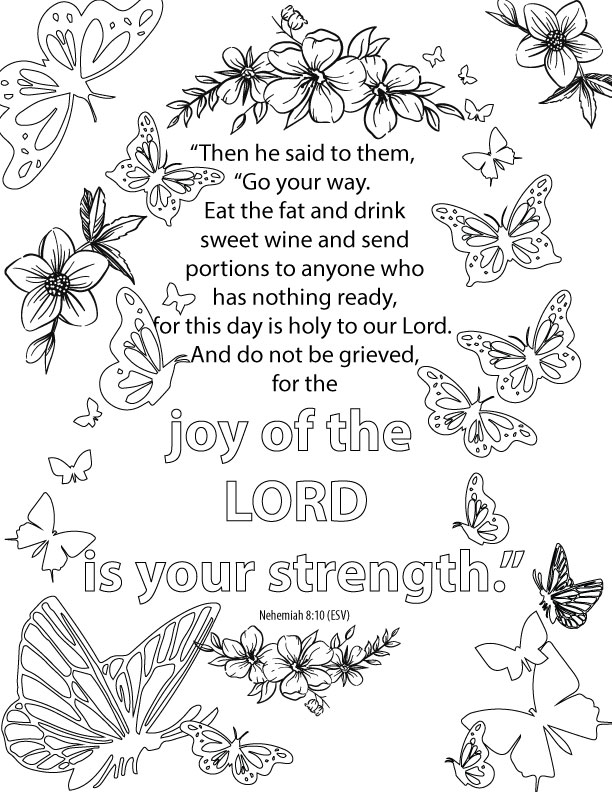
August 8, 2022 – Nehemiah 8:10

” … the joy of the Lord is your strength.” Have you ever wondered exactly what that meant or means for us today? Click here to read a recent post about the joy of the Lord.

Uncategorized

Joy is Having a Feast

Photo by Taryn Elliott on Pexels.com

“Taste and see that the LORD is good; blessed is the one who takes refuge in him.”

Psalm 34:8

David, a man after God’s heart, who wrote the psalms, encourages the reader in Psalm 34 to experience God for themselves. We can hear about God’s goodness but David invites us to experience His goodness. We can’t really experience anything just by hearing about it. But when we use our other senses we can become fully engaged. We are invited to taste and see for ourselves God’s goodness.

All throughout the Bible there are passages that speak of feasts, festivals and food. Adam and Eve were placed in a garden with food, (Genesis2:8). In the Old Testament we can read about seven feasts that point to Christ. The Passover, (Leviticus 23:4-8); Unleavened Bread, (Leviticus 23:6); First Fruits, (Leviticus 23:10); Feast of Weeks, (Leviticus 23:16); Feast of Trumpets,(Leviticus 23:24); Day of Atonement, (Leviticus 16, 23:26-32); and the Feast of Tabernacles, (Leviticus 23:34). In the New Testament, God’s goodness was experienced at the Wedding in Cana (John 2:1-11) where Jesus turned water into wine. Jesus fed 5000 (Matthew 14:13-21) with five loaves of bread and two fish, another miracle that people were able to experience God’s goodness through food. Jesus and His disciples ate at the Last Super (Matthew 26:17-30) in the upper room and fellowshipped. In Revelation we read of the marriage super of the Lamb (Revelation 19:6-9) where we will celebrate finally being united with Jesus face to face.

Food grows us, food can heal us, food fuels us, it sustains us. Is any coincidence that God’s word is the bread of life? When we taste and see, we are experiencing. When we read God’s word, we are tasting and seeing, we are fueling our souls and fortifying our bodies. Proverbs 4:20-22 “My son, pay attention to what I say; turn your ear to my words. Do not let them out of your sight, keep them within your heart; for they are life to those who find them and health to one’s whole body.”

God speaks to us through His word, we can experience a revelation or a “ah ha” moment. We learn and when we learn we are growing our knowledge. We grow when we partake of God’s word daily. We can enhance our experience by fellowshipping with others and reading His word together. It’s kind of like sharing a meal with someone when we share God’s word and fellowship with others in His word, we are tasting and seeing, experiencing. We are not only experiencing the taste of food but enjoying company of the person or persons with whom we are eating. And what a joy it is, either sharing a meal or sharing God’s word and hearing from God Himself.

Taste and see that the Lord is good today. Feast on His word, experience Him by reading His word and sharing it with others.

Uncategorized

Joy of the Lord is My Strength

Photo by Alexandr Podvalny on Pexels.com

Nehemiah 8:10 – “… the joy of the Lord is your strength.” Ever wondered what that really means? How can the the Lord’s joy be our strength? Well, first we need to look at the who, when, where and why of the passage. We need to read the chapters and verses before it. So, let’s journey through the passages.

Most scholars believe The book of Nehemiah was written by Nehemiah himself. Nehemiah exhibited exceptional leaderships qualities and he was a man of prayer. He depended deeply on God and knew how to draw strength and assurance from Him. Nehemiah was a volunteer of sorts. He was deeply affected by the dismal state of Jerusalem and I believe God used this to move Nehemiah forward in rebuilding the wall and spiritually restoring the people of Israel.

“… the joy of the Lord is your strength

Nehemiah 8:10

Without going into too much background, I just want to look at verse 10 – “Nehemiah said, “Go and enjoy choice food and sweet drinks, and send some to those who have nothing prepared. This day is holy to our Lord. Do not grieve, for the joy of the Lord is your strength.” How does the Lord’s joy give me strength?

Chapter 8 starts with Ezra, a leader of the Jews on the first day of the seventh month read the law to an assembly of people, men, women and children, and all who were able to understand. As they listened to Ezra the people began to weep for they knew how disobedient they had been to God. This was known as the Feasts of Trumpets. Everyone was to stop working and remember the Lord. Everyone started out praising and worshipping God. As Ezra continued to read the law, they wept and mourned because they became aware of how disobedient they had been. The reading and receiving of the law was to be a joyous time. God’s Word has the power to convict, convert and revive and we can be joyous when we are convicted because true conviction leads to repentance and restoration with God. “For the kind of sorrow God wants us to experience leads us away from sin and results in salvation. There’s no regret for that kind of sorrow. But worldly sorrow, which lacks repentance, results in spiritual death.” – 2 Corinthians 7:10 (NLT). When we repent and change we are restored and that brings us JOY! GOD’S JOY!

How happy are you when someone you’ve hurt forgives you? Have had to repent to someone for hurting them, especially someone you love? When you realize what you have done and feel bad, or sorrowful and want to make things right, you go to that person, apologize and ask for forgiveness. When that person forgives you, you both are so happy and the relationship is restored. How happy have you been when someone apologizes for hurting you?

In Zepahnaih 3:17 – The Lord your God is with you, the Mighty Warrior who saves.
He will take great delight in you; in his love he will no longer rebuke you, but will rejoice over you with singing.” God is love – 1 John 4:8 & 16 1 John 4:8 – But anyone who does not love does not know God, for God is love. 1 John 4:16 – We know how much God loves us, and we have put our trust in his love. God is love, and all who live in love live in God, and God lives in them.  John 3:16 – For God so Loved the world, He gave His only Son (paraphrased).

He will take great delight in you … will rejoice over you with singing.’

Zepahnaih 3:17

All we have to do is receive that forgiveness and His love!!! He takes joy in us when we turn from our sin and and are deeply sorry for what we have done. It is a time of restoration and a time to celebrate like people did in verse 10 of Nehemiah. Because God is joyful in my repentance I can draw strength from that.