

encouragement, healing, hope, Trust God

The Potter and the Clay Pt 3: Hope Beyond the Broken Pieces

©2026 The Kedge Anchor (AI assisted)

Welcome back.

Last week, we’ve seen how a broken pot can be restored and used again, sometimes by returning to their original purpose and this week we’ll see how sometimes God can transform us for an entirely different one.

In part 2, the pot broke to the point that it could no longer be repaired and used as it once was, to hold water for flowers. One piece had shattered into tiny fragments that could not be put back together.

But that didn’t stop the potter from restoring it.

Instead of trying to replace the missing piece, the potter left that space open, creating a hole large enough for light to shine through when a candle was placed inside. The light not only transformed the pot, but also helped illuminate the dark, cluttered corners of the house that the potter had been working to clean out.

A few days later, the potter decided to make another pot. This one would be shorter and wider, designed to hold some of his tools. After completing the entire process of kneading, sculpting, forming, and firing, the potter placed it on his worktable and began using it for its intended purpose.

Until one day, it was accidentally knocked over.

The pot fell hard from high above the floor and shattered into countless pieces. It was beyond repair. The pieces could never be put back together to make the pot it once was.

But the potter was resourceful. He didn’t want to throw the broken pieces away. He loved finding ways to restore and repurpose his work.

So he took those shattered pieces and ground them down until they became smooth, fine, silky sand.

The potter had an old wooden tray tucked away in the corner of the house, the very corner he had recently cleaned out. He brought it out and filled it with the newly ground pottery.

Then he went into his garden and chose five smooth stones to place in the sand, creating a small rock garden. He gathered a few twigs, smoothed them down, and made a tiny rake.

Now, from something that had been completely shattered, the potter had created something peaceful—a place to slow down, reflect, and calm his mind on stressful days.

The first pot taught us that the potter knew what he was creating, even when the pot itself didn’t know. It had to be pressed, molded, shaped, and literally go through the fire before the potter’s purpose could be fulfilled.

The second pot was broken, but its restoration gave it a new purpose, to shine light through the very place where something was missing.

The third was shattered beyond repair. It could never become the same pot again. Instead, it was transformed into something entirely different, a place of peace and calm.

Can you relate to the brokenness of these pots?

Do you see yourself in one of them?

Maybe you’ve experienced a time when you were so broken that you wondered if you could ever function the way you once did.

Maybe God restored you and brought you back to a place where you could once again do what you were created to do.

Or maybe your brokenness left marks that could not simply be put back together. Maybe God took those broken places and gave them a new purpose, using them to shine His light into someone else’s darkness.

And maybe you feel like the third pot. So shattered that you wonder if there could possibly be anything left for God to use.

But there is.

God can work through our brokenness. He can restore. He can transform. And He can take the pieces we thought were useless and create something we never imagined.

Romans 8:28 reminds us:

“God works all things together for the good of those who love Him.”

The brokenness hurts.

The transformation can hurt, too, as God molds us, reshapes us, and teaches us to trust Him with the pieces.

But remember this: we were created by Him and for Him.

Our brokenness does not change that.

God can use the restored places in our lives. He can use the holes. He can use the scars. He can even use the pieces we thought were too broken to matter.

Sometimes He restores us so we can return to what we were created to do.

Sometimes He gives us a completely new purpose.

And sometimes He takes the broken pieces and creates something that brings peace, not only to us, but to someone else who is walking through their own brokenness.

So invite God into your brokenness.

Give Him the pieces you cannot fix.

Allow Him to restore you. Allow Him to transform you. And trust the Potter with the process.

Because He is not finished with you.

He is our HOPE.
encouragement, hope, Stress, Trust God, Uncategorized

The Potter — Part 1 – When God Is Shaping Your Life: The Potter and the Clay

© 2026 The Kedge Anchor

Understanding the Process When Life Doesn’t Look Like You Expected

When God created us, He had a purpose in mind.

I think about an artist creating a piece of art. An artist is usually inspired by something, and before the first brushstroke or pencil line is made, there is often a plan—a design and a purpose.

Sometimes the purpose is simply to add beauty. Sometimes it’s functional: a bowl to hold something, a cup from which to drink, a vessel to hold flowers, or a lamp to carry light.

God uses the imagery of a potter and clay to describe our relationship with Him:

“Yet you, LORD, are our Father. We are the clay, you are the potter; we are all the work of your hand.”
— Isaiah 64:8 (NIV)

God formed us in His image:

“Then God said, ‘Let us make mankind in our image, in our likeness…’”
— Genesis 1:26 (NIV)

And Scripture tells us that God has plans for us:

“For I know the plans I have for you…”
— Jeremiah 29:11 (NIV)

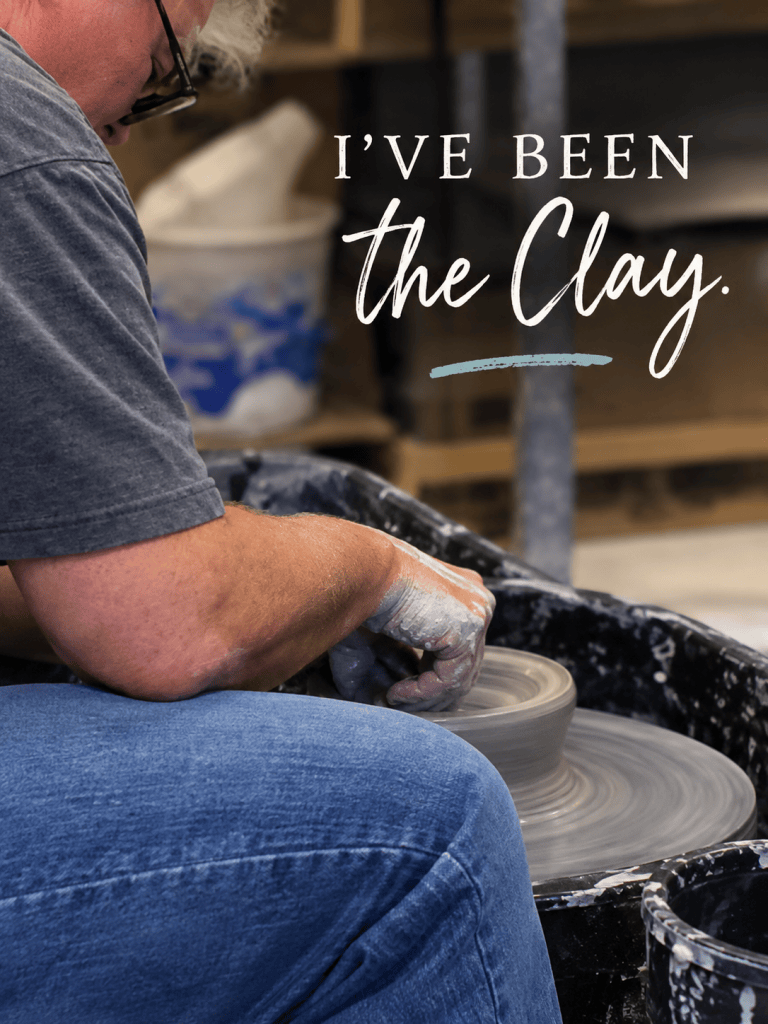
Think about a potter sitting down at the wheel with a lump of clay.

Straight out of the package, the clay doesn’t have much aesthetic form. It’s soft and pliable, and because it is soft, the potter can shape and mold it.

But before the potter begins, there is already a plan, a design, and a purpose in mind.

The clay is placed on the wheel and the process begins.

It is slapped down onto the wheel and pounded. It is kneaded, much like bread dough, to get the air out. The potter works the clay for a few minutes, and as the clay is kneaded, it becomes warm and softer.

Then the clay is placed back on the wheel.

The wheel begins to turn.

The potter wraps his hands around the lump of clay and begins to give it form.

Sometimes the clay begins to dry from the friction of the potter’s hands. So the potter wets his hands and adds water to the clay, continuing to shape and form it.

Then comes the pressure.

The potter applies pressure from the top, opening up the center and hollowing out the inside. Pressure from certain points on the outside creates grooves and curves, giving the piece its shape and character.

The potter forms the lip and smooths the edges. He gives the piece one final spin, checking it and looking it over.

The wheel stops.

The potter takes a piece of string, slides it underneath the newly formed pot, and lifts it from the wheel.

The pot is taken to a shelf with other pieces to dry.

And now…nothing seems to be happening.

The clay has already been through a lot—pounding, kneading, spinning, pressure from all sides, pressure from the top, being hollowed out and shaped.

Now it simply rests.

Days pass.

Other pieces come and go, but this one remains on the shelf, waiting until the potter is ready.

Then the potter takes it down.

It is dry.

It is ready for the kiln.

The temperature inside a kiln can reach more than 2,000 degrees Fahrenheit, and the pot may remain there for hours. The firing process is intense, but when it is complete and everything has cooled, the potter takes the piece out and prepares it for its intended use.

And I can’t help but think about how it is with us.

How many times have we felt like that lump of clay?

Pounded.

Pressed.

Shaped.

Emptied.

Stretched.

Waiting.

Maybe you’ve been in a season where it feels like God is doing something in your life, but you don’t understand what He’s doing.

Maybe you’ve experienced pressure from every direction.

Maybe you’ve felt like you’ve been emptied out.

Or maybe you’re in that place where nothing seems to be happening at all.

You’re just waiting.

But the clay doesn’t know what the potter is making.

The potter does.

God sees what we cannot see.

And maybe that’s where Romans 8:28 begins to take on a little more meaning:

“And we know that in all things God works for the good of those who love him…”

Not everything that happens to us looks or feels good.

But God can work through all things.

The clay has no idea what it will become.

It only knows what it’s experiencing right now.

And sometimes, I think we’re the same way.

So pause for a moment and think about your own brokenness.

Where has it brought you?

How have you healed?

Maybe you haven’t healed yet.

Maybe you’re still in the process.

There is hope.

And there is more to this story—because there is more to our brokenness than we may realize.

Stay tuned for Part 2.